Skip to main content

June 16, 2026
The United States defense enterprise spends nearly $700 million a day on readiness. Despite that investment, major readiness indicators continue to move in the wrong direction.
Programs take longer to field: Major defense programs that once reached Initial Operating Capability (IOC) in roughly six years now take nearly 12 years.
Production takes longer to scale: Programs that once reached full-rate production in 3-5 years now routinely require 7-10 years, with some still not achieving full production after a decade.
Maintenance delays continue to increase: Nearly 3 out of 4 Air Force aircraft entering depot maintenance are delayed - a rate that has risen from 31% to 73% in just five years.
These are not isolated statistics. They are indicators of a broader trend: despite unprecedented levels of investment, the defense enterprise is struggling to translate resources into readiness outcomes.
On the front line, decisions happen in seconds. In the enterprise, delivery takes years.
We’ve sat with the people living this reality. The maintainer keeping a personal list of 900 hard-to-find parts because she did not trust the supply chain to deliver. The engineer holding design changes in her own log because the system was unable to. Every one of them managing a piece of readiness manually because of an architecture built for oversight, not execution.
Their heroics are what keeps the enterprise running, but they are also the clearest signal the system is failing.
The cause? A quagmire of industrial suppliers, government agencies, disconnected systems, and manual processes that prevents the enterprise from operating as a continuously coordinated system. This quagmire gives rise to the core problem: The Readiness Gap. A dangerous chasm between what the front line needs and what the national security enterprise can deliver. It is structural and it is compounding.
We’ve spent the better part of a decade working inside the programs closest to this problem, alongside many of those who have been living it. Today, more than $140 billion in defense programs are actively managed on our platform.
What we learned is this: acquisition problems, supply chain problems, and sustainment failures are just symptoms. The underlying failure is the inability of the enterprise to continuously coordinate execution across suppliers, operators, agencies, and industry at the speed modern missions require. What has been missing is not the effort or necessary investments. It is the system to make all of it add up to improving outcomes.
Over the past decade, we have come to understand that the Readiness Gap cannot be solved through acquisition reform, supply chain modernization, sustainment improvements, or any other isolated initiative alone.
The challenge is larger than any individual function because readiness itself requires the coordinated execution of suppliers, operators, agencies, maintainers, logisticians, and program offices across the defense enterprise.
We call this Enterprise Readiness.
Enterprise because no single organization owns readiness. Readiness because the ultimate measure of success is whether the force can execute when called upon.
The term reflects a shift from treating readiness as a point-in-time assessment to managing it as a real-time condition that is continuously achieved.
We have never had a system specifically designed to maintain that condition, until now.
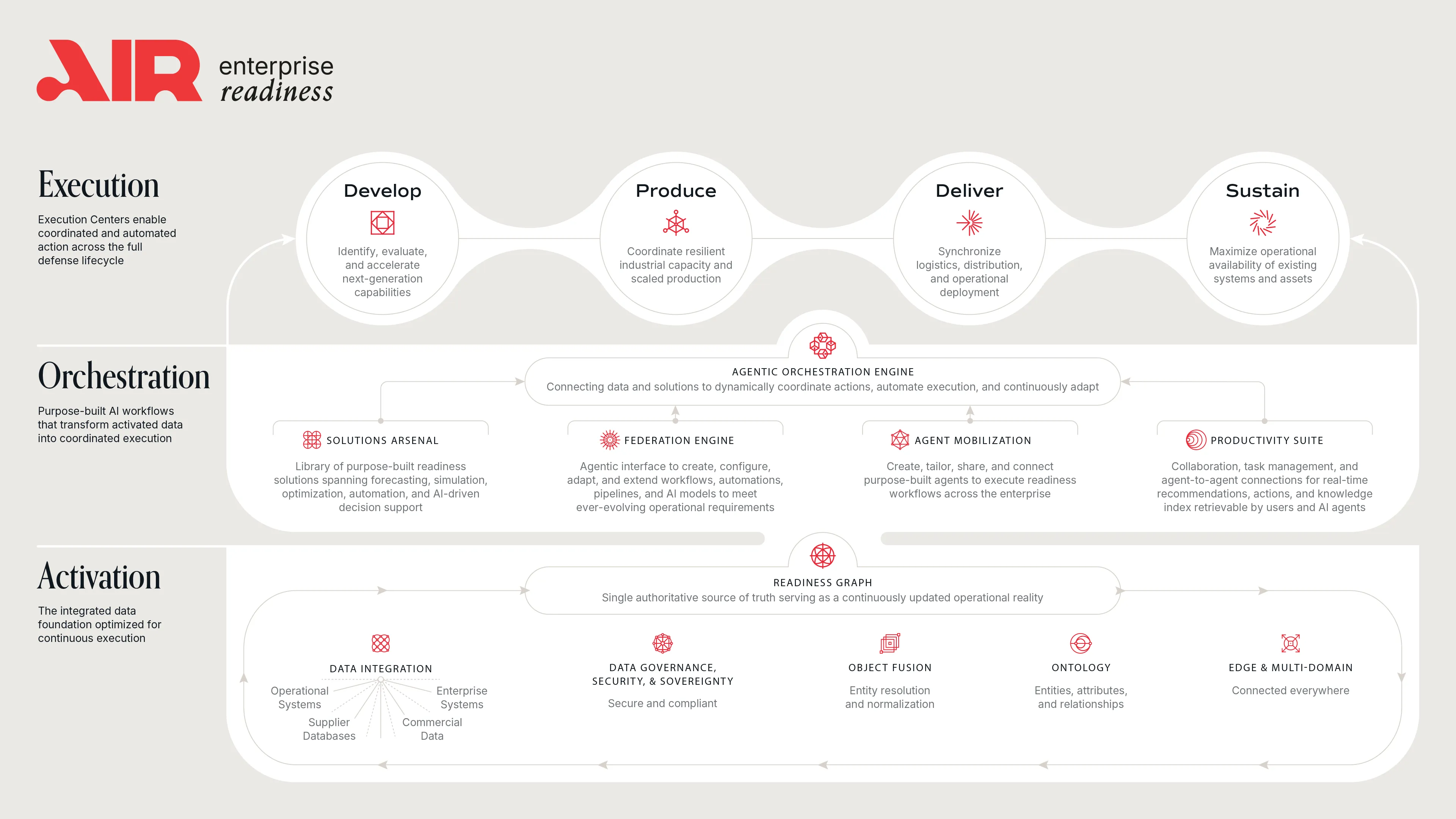
What you see here is the blueprint for Enterprise Readiness. The AI-native architecture required to continuously understand demand, coordinate resources, and execute across the defense enterprise.
It starts with the Activation layer that connects and continuously updates data from across government systems, industrial suppliers, operators, and commercial sources to create the Readiness Graph - a shared operational data foundation for readiness.
On top of the data sits the Orchestration platform, where AI-powered capabilities, adaptive workflows, and coordinated human-machine execution transform information into action.
Finally, the Execution layer delivers outcomes through mission-specific workflows aligned to Execution Centers that span the full defense lifecycle, enabling the enterprise to continuously identify capability needs, scale production, coordinate delivery, and sustain mission-ready assets.
Today we are also changing our name. Govini reflected where we started. Air reflects where we are going.
Over the years, our work has expanded far beyond acquisition, industrial analysis, or supply chain visibility. The challenge we found ourselves increasingly helping customers with was larger: coordinating readiness across an ecosystem of suppliers, operators, agencies, and industry partners.
We chose the name Air because readiness must move continuously across that ecosystem. It must connect organizations that have historically operated in isolation and enable coordinated execution at the speed modern missions require.
Air is the company. Enterprise Readiness is the platform. The team, mission, and commitment to our customers remain unchanged.
If you are a current Ark customer, the platform you use today does not change. The UI stays the same, and how you purchase the platform stays the same. We will be making improvements and updates over time. You will know before anything changes, and we will make it easy.
Nothing about our commitment to your mission changes. The name on the door does.
The defense enterprise does not need another reporting layer. Nor does it need another isolated modernization initiative.
What it needs is the ability to continuously coordinate execution across the systems, organizations, and stakeholders responsible for readiness.
The opportunity in front of us is to make readiness, the actual real-time condition of the force, something the enterprise can continuously understand, manage, and sustain.
The people inside the defense enterprise are extraordinary. Their ingenuity, perseverance, and commitment are the reason the system has continued to function despite compounding complexity. Our goal is not to replace that effort. It is to give those people a system capable of supporting the mission they are already carrying.
The weapons, platforms, and capabilities produced by the United States are among the most advanced in the world. The architecture that supports them should be worthy of them.
That is what we are building.
Read our full press release for more.
This announcement is just the beginning. Visit me on LinkedIn to share your thoughts, ask questions, and join the mission to Close the Readiness Gap.