
The Readiness Gap
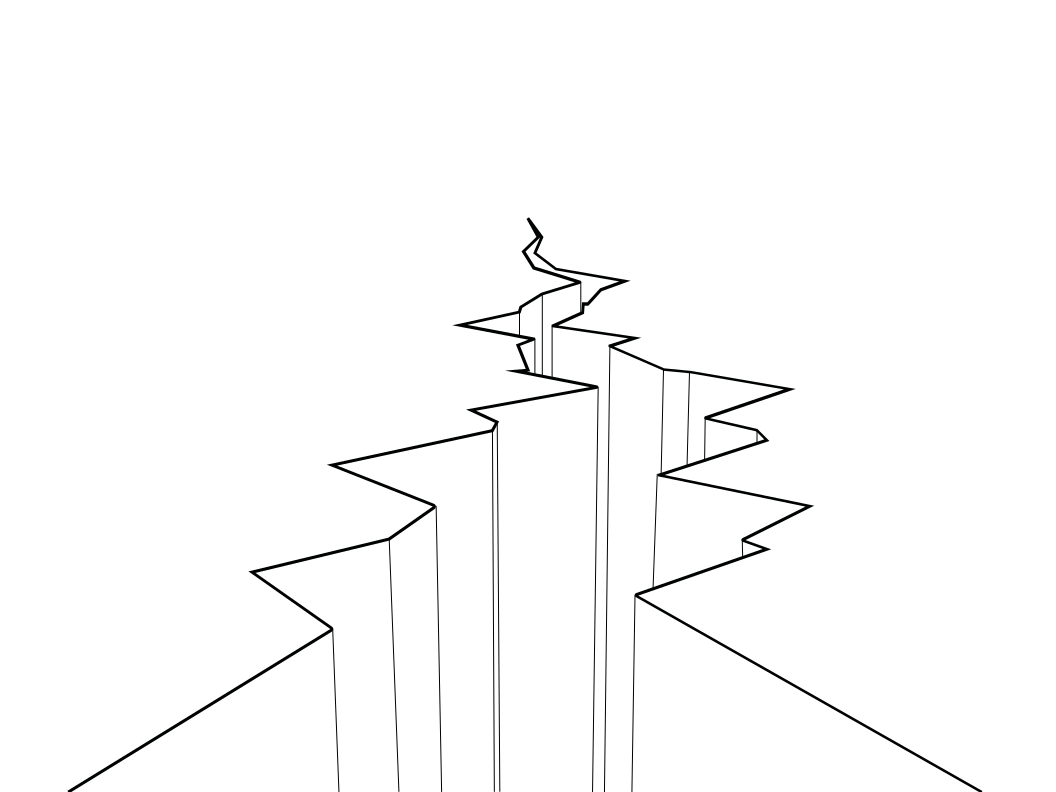
The Readiness Gap is a dangerous chasm between what the front line needs and what the national security enterprise can deliver. This is not merely a government problem: the enterprise includes the industrial base—prime contractors, sub-tier manufacturers, and commercial firms that are as central to readiness as the platforms themselves. The gap is structural, not incidental. As threats multiply and equipment ages, the Readiness Gap keeps growing.
On the front line, decisions happen in seconds.8 Edge processing has compressed long-range kill chains from 10-20 minutes to a few seconds. In the national security enterprise, delivery takes years. The average Major Defense Acquisition Program (MDAP) now requires almost 12 years to deliver initial operational capability—a figure that grew by 18 months in a single year.9
Operational tempo has accelerated.
Institutional tempo has not.
Institutional tempo has not.
The Readiness Gap manifests everywhere:
Only 2 of 27 combat aircraft platforms met their mission-capable goals in FY24.10 The KC-46, the Air Force’s newest and most advanced aerial refueler, has consistently failed to meet availability and capability standards in every year since FY19.11 Roughly 6 in 10 KC-46s are able to perform any mission, meaning nearly half of the fleet is unavailable to support the fight at any given time. Even fewer are able to perform all of their missions at any given time.
The Army’s core combat platforms—the M1 Abrams, M2 Bradley, and UH-60 Black Hawk—were designed in the 1970s and fielded in the 1980s. Four decades of upgrades have kept them operational. After multiple failed and cancelled modernization programs, replacements will not arrive until these platforms are 50+ years old.12
Just over 60% of the Navy’s surface fleet is combat-surge ready when the portion required to meet operational requirements is 80%.13
The Navy’s Constellation-class frigate was billed as a “low-risk” modification of an existing European design and chosen specifically to avoid the failures of past programs. However, after years of design instability, delivery delays, and ballooning costs, the Navy cancelled the program in November 2025.14 Only two ships were ever authorized, leaving the surface fleet without the combatant it spent years and billions trying to build.
Delivery of the Sentinel ICBM—the long-overdue replacement for America’s land-based nuclear deterrent—has slipped by four years and incurred a $36 billion single-year cost increase. Years into development, neither the Air Force nor contractor has finalized software design or delivery schedules.15 The Minuteman III it was designed to replace has been on nuclear alert since 1970.
Deferred maintenance across the Coast Guard’s cutter fleet grew by 264% between FY18 and FY24.16 Preventable failures that routine maintenance could have avoided now degrade the fleet’s availability to conduct missions. Serious equipment failures have already climbed 21%, and crews increasingly strip parts from one cutter to keep another running.17
Only 8% of passenger vehicles and 27% of commercial trucks entering the country by land are scanned by non-intrusive technology systems, despite a mandate to reach 100% by 2027 and more than $2 billion committed to advanced scanning portals.18 The front door to the U.S. homeland remains open to exactly what this technology was bought to stop—weapons, nuclear and radiological material, illicit drugs like fentanyl, and more.
Readiness shortfalls proliferate across the enterprise: in new capabilities developed too late (or not at all), in platforms that cost more and take longer to produce with each passing year, in assets that can’t be sustained to acceptable mission-capable rates, and in logistics that can’t deliver for those on the front lines.

See Air in Action
The Readiness Gap will not close through more reports, delayed reviews, or heroic workarounds.
See how Air Enterprise Readiness platform helps leaders understand readiness constraints, coordinate execution, and act with confidence before risk reaches the mission.
Long-Range Kill Chains: Edge Processing," Air & Space Forces Magazine, accessed May 18, 2026, https://www.airandspaceforces.com/long-range-kill-chains-edge-processing/.
U.S. Government Accountability Office, Weapon Systems Annual Assessment: DOD Leaders Should Ensure that Newer Programs Are Structured for Speed and Innovation, GAO-25-107569 (Washington, DC: GAO, 2025).
Diana Maurer, testimony on Military Readiness: Implementing GAO's Recommendations Can Help DOD Address Persistent Challenges across Air, Sea, Ground, and Space Domains, before the Subcommittee on Readiness and Management Support, Committee on Armed Services, U.S. Senate, March 12, 2025, GAO-25-108104.
U.S. Government Accountability Office. Aerial Refueling Tankers: Air Force Needs More Focused Metrics and a Risk-Based Mitigation Plan to Improve Sustainment. GAO-26-109154 (Washington, DC: GAO, 2026).
The Heritage Foundation. "U.S. Army." In 2026 Index of U.S. Military Strength, edited by Dakota Wood. Washington, DC: The Heritage Foundation, 2026. https://www.heritage.org/military-strength/assessment-us-military-power/us-army.
Admiral James W. Kilby, testimony on fiscal year 2027 budget request for military readiness, before the Subcommittee on Readiness, Committee on Armed Services, U.S. House of Representatives, April 15, 2026.
Brandon J. Weichert, "America Has Finally Put an End to Its Constellation-Class Frigate Nightmare," The National Interest, December 2, 2025, https://nationalinterest.org/blog/buzz/america-finally-put-end-to-constellation-class-frigate-nightmare-bw-120225; U.S. Government Accountability Office, Navy Frigate: Unstable Design Has Stalled Construction and Compromised Delivery Schedules, GAO-24-106546 (Washington, DC: GAO, 2024).
U.S. Government Accountability Office, National Security Snapshot: Intercontinental Ballistic Missile Modernization Faces Critical Risks and Opportunities, GAO-26-108755 (Washington, DC: GAO, February 18, 2026); U.S. Government Accountability Office, Weapon Systems Annual Assessment: DOD Leaders Should Ensure that Newer Programs Are Structured for Speed and Innovation, GAO-25-107569 (Washington, DC: GAO, 2025), 32.
U.S. Government Accountability Office. Coast Guard: Actions Needed to Address Cutter Maintenance and Workforce Challenges. GAO-25-107222 (Washington, DC: GAO, 2025).
U.S. Government Accountability Office. Coast Guard: Actions Needed to Address Cutter Maintenance and Workforce Challenges. GAO-25-107222 (Washington, DC: GAO, 2025).
U.S. Government Accountability Office. Land Port Inspections: CBP Should Improve Performance Data and Deployment Plans for Scanning Systems. GAO-25-107379 (Washington, DC: GAO, 2025).